Design Specification INFO 360 SPR 2026

UAAI Adara, Sanam, & Emma

UAAI gives UW undergrads instant, validated answers to advising questions — so students get clarity and advisors get time back.

TeamAdara, Sanam, & Emma
RoleDesigners
TypeWebsite
ToolsFigma
scroll
01 The Problem

What problem exists, and why it matters.

Academic advising at UW is structurally strained. With over 47,000 undergraduates and a limited advising staff, timely guidance is not guaranteed. Our surveys found nearly half of students struggled to get an appointment — and many stopped trying entirely. Students navigating course planning, major changes, or graduation requirements are left with tools that surface data but offer no interpretation. Stress peaks during the highest-stakes moments: registration windows, declaration deadlines, and graduation audits — exactly when students need guidance most. Existing alternatives don't fill the gap: UW's own platforms are admin-first, EAB Navigate is advisor-facing only, and ChatGPT generates confident but UW-inaccurate answers. Our core research insight: students don't need more information — they need the right information at the right moment.
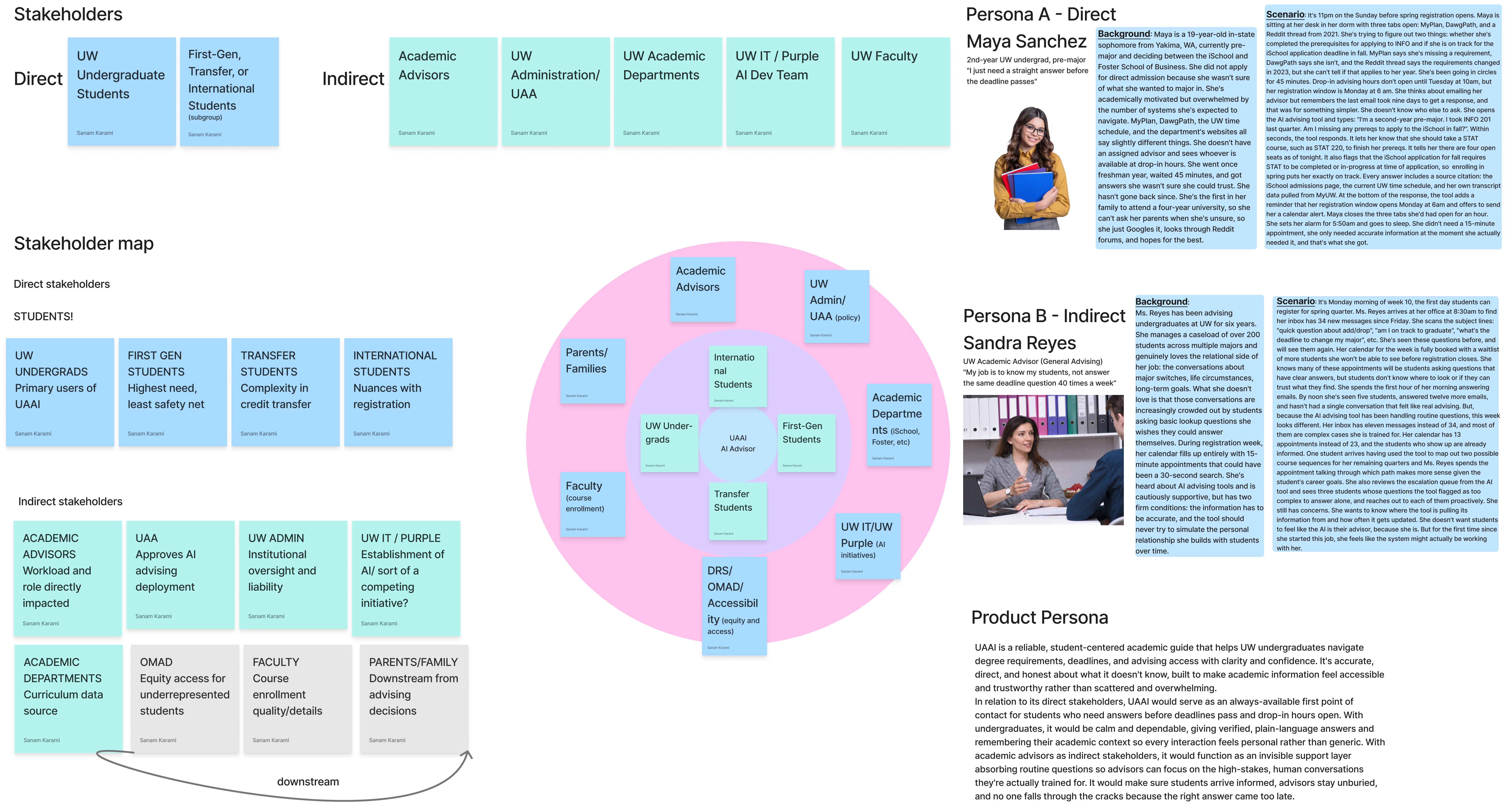
User personas

User Research Highlights

6 of 13 students
struggled to get
an advising meeting.

10 of 13 said they'd
use an AI advisor
for routine questions.

Only 5 of 13 felt their
advisor knew them
personally.

"Even advisors themselves feel the system is broken for routine questions and are open to AI help — but the threshold for trust and accuracy is high."
— UW Academic Advisor Interview

Advisor Interview

"Many questions don't need a full 15-minute meeting — that creates unnecessary friction for both sides. I'd welcome a tool that handles simple lookup questions, as long as advisors aren't removed from the equation."

— UW Undergraduate Academic Advisor

Competitive Landscape

UW MyPlan / DawgPath / MyUW

Surfaces accurate data — but leaves all interpretation to the student. Admin-first by design.

EAB Navigate

Streamlines advisor workflows — but does nothing for students who can't get a meeting.

ChatGPT / General AI

Available 24/7 and conversational — but no UW-specific data and frequently inaccurate.

UAAI fills the gap

Always-on + verified UW data + student memory + escalation to a real advisor.
02 Evaluation

How we tested the design.

Usability testing

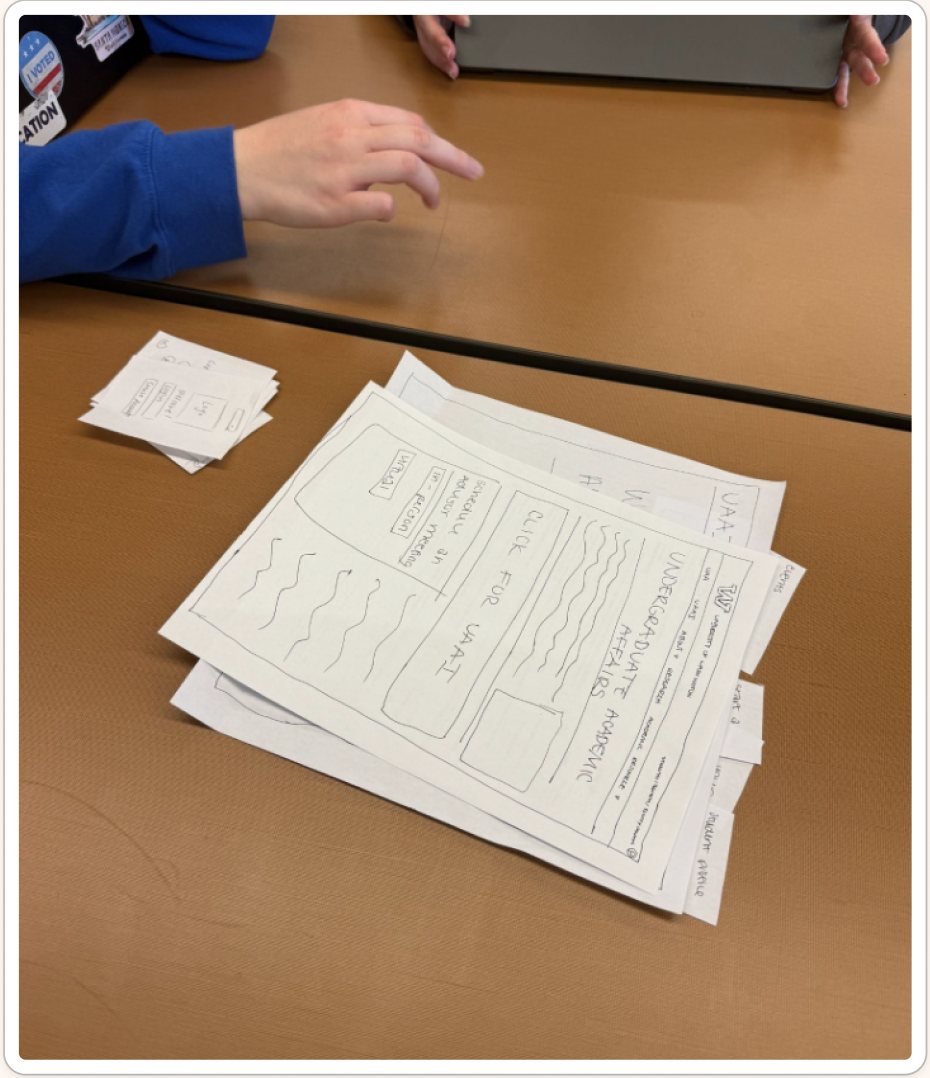
We evaluated UAAI through two rounds of paper prototype usability testing using a Wizard of Oz approach, followed by a heuristic evaluation of the high-fidelity Figma prototype. Each round used situated task scenarios — realistic situations framing why a student would use the tool — and a think-aloud protocol to surface confusion in real time.

Who UW undergraduates from INFO 360 — two separate groups (Group 12 and Group 9) tested in separate rounds. As current students familiar with MyPlan, DARS, and UW advising, their feedback reflected real advising needs, not hypothetical ones.?
Tasks Six situated scenarios: entering UAAI from the UW advising page, exploring the dashboard, asking the AI whether current classes count toward a major, escalating to a real advisor, reviewing academic standing on the profile, and distinguishing between similar-sounding features.
Worked The four-tab nav structure was understood as navigation. The Academic Snapshot was appreciated as a useful summary. The History tab — revisiting past conversations — was seen as a clear and valuable feature. The core concept of a UW-connected AI advisor resonated with all participants.
ProblemsChat was buried — users explored every other tab first. "Need more help" was mistaken for tech support, not advisor booking. Quick Actions vs. Quick Access caused consistent confusion across both rounds. No login meant users felt depersonalized. Users entering from the UW advising page couldn't tell when they'd entered UAAI at all.
Learned The same core problems — buried chat, redundant features, unclear entry point — appeared independently across both groups, confirming they are systematic. Real users surfaced issues no brainstorm predicted. Trust in an AI answer depends as much on the cited source as the content itself
03 Design Rationale

Why we made the choices we made.

Every design decision in UAAI traces back to a gap our research exposed that students continue to miss deadlines, avoiding questions, and navigating fragmented tools alone because the advising system was built around advisor availability, not student need.

Why this solution? Nearly half of surveyed students reported struggling to get an advising meeting, and many had stopped trying entirely, expecting delays. The current system with drop-in hours, fragmented platforms, advisor overload have failed students most during their highest-stakes moments: registration deadlines, major changes, graduation checks. An always-available AI assistant trained on verified UW-specific data gives students answers the moment they need them, without requiring a 15-minute appointment that cannot get scheduled for a month for a 30-second question.
Why better than other ideas? We analyzed four existing solutions. UW's own tools (MyPlan, DawgPath, MyUW) surface accurate data but leave all interpretation to the student as they're admin-first by design. EAB Navigate is advisor-facing and does nothing for students who can't get a meeting. ChatGPT is available 24/7 but has no UW-specific data and frequently generates confident but inaccurate answers. AdmitHub/Mainstay covers admissions only, not ongoing academic advising. UAAI is the only option that combines always-on availability, verified UW data, persistent student memory, and a built-in escalation path to a real human advisor.
How did research shape it? Five key insights from our advisor interview, student survey, and affinity mapping drove specific decisions. Access being broken meant Chat had to be the landing screen after login with both rounds of paper prototype testing confirmed it got buried when it competed with equal-weight tabs. Trust requiring accuracy drove source citations on every answer. Personalization being the gap between a tool and another UW website drove UW NetID login and persistent profile memory. The fragmented tool ecosystem justified UAAI as a single student-first interface. With both students and advisors agreeing AI belongs only in a specific lane drove the persistent "Book Advisor" button on every page.
What trade-offs? We deprioritized Degree Audit Visualization, Multi-Language Support, and direct integration with a student's known advisor list to have all identified in ideation but placed in "nice to have" or "long shot" on our impact/feasibility matrix. A smaller, accurate feature set builds more trust than a sprawling tool that occasionally gets things wrong. We also launched UAAI on its own branded domain rather than embedding inside the UW advising site, and round 2 user testing showed users entering through the UW page couldn't tell when they'd entered UAAI or what the product even was.
04 Design Solution

What we actually built.

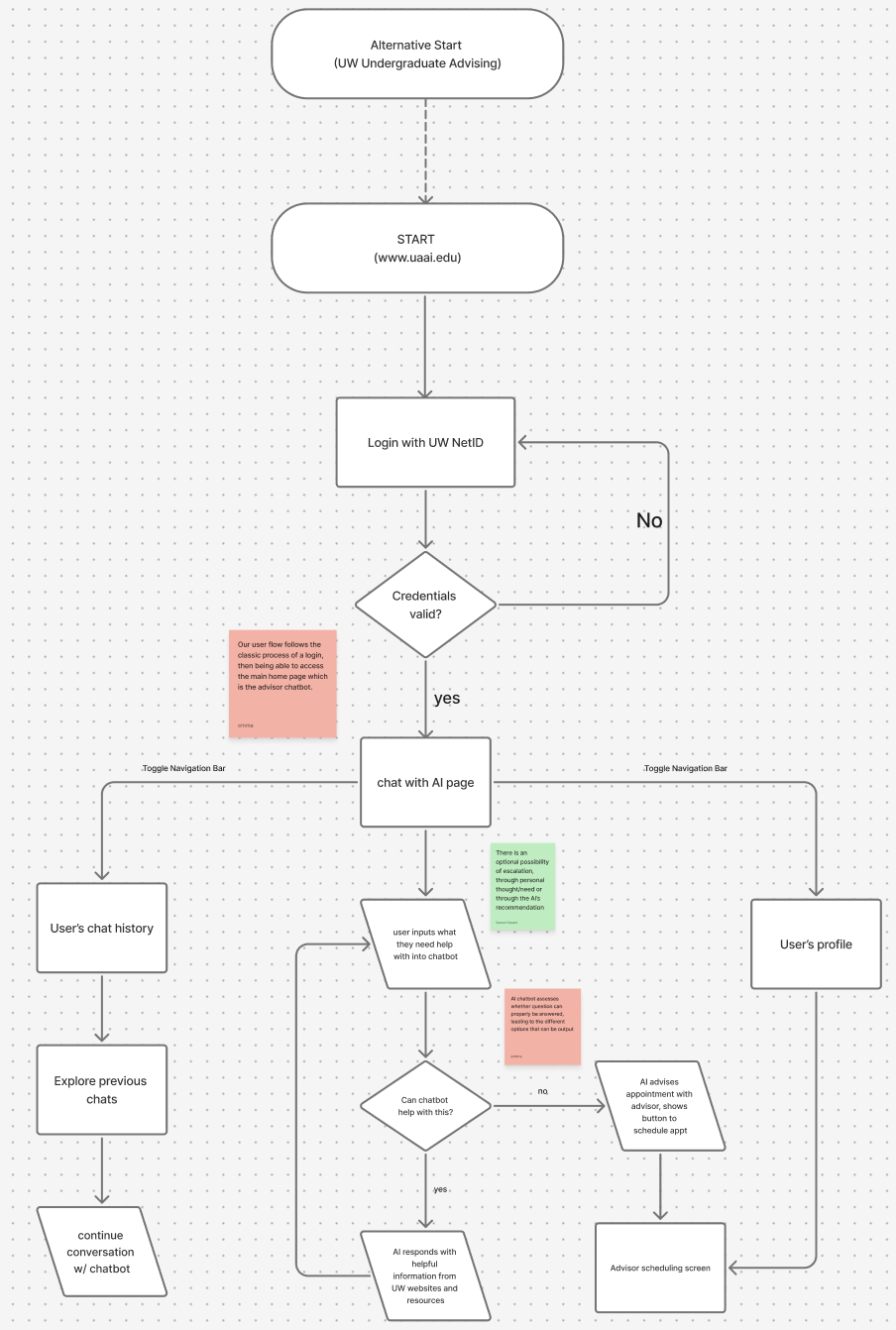
UAAI is a UW-specific AI advising assistant that provides accurate, instant answers to routine academic questions 24/7, while routing complex decisions to a real human advisor. Students log in with their UW NetID, land directly on an AI chat interface, and ask questions in natural language. The AI responds with verified, plain-language answers that cite their sources and remembers each student's academic context with major, year, credits, registration date, so every interaction feels personal rather than generic.

Try the Working Prototype

Open UAAI → | Watch Demo →
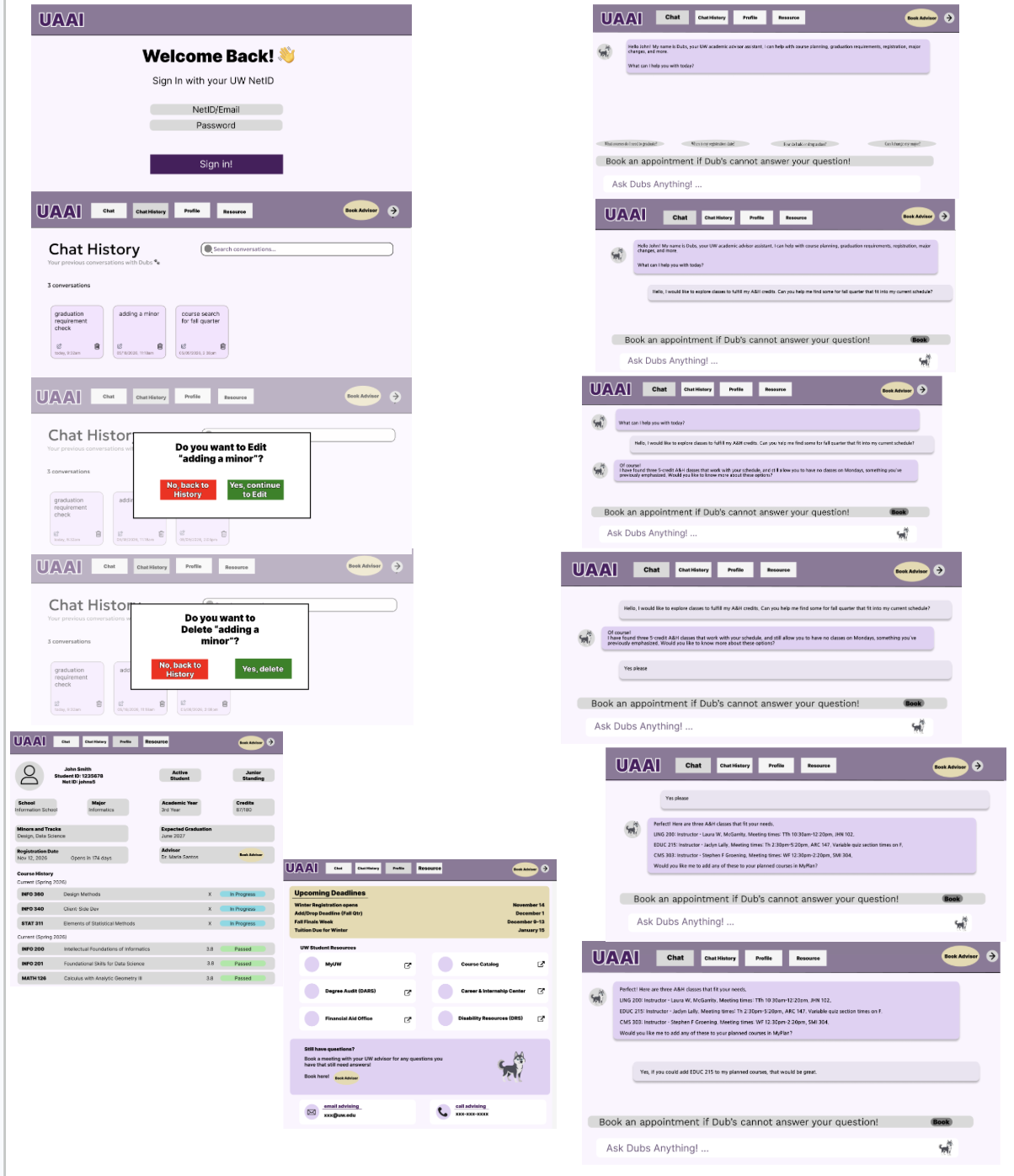
Hi-fi prototype
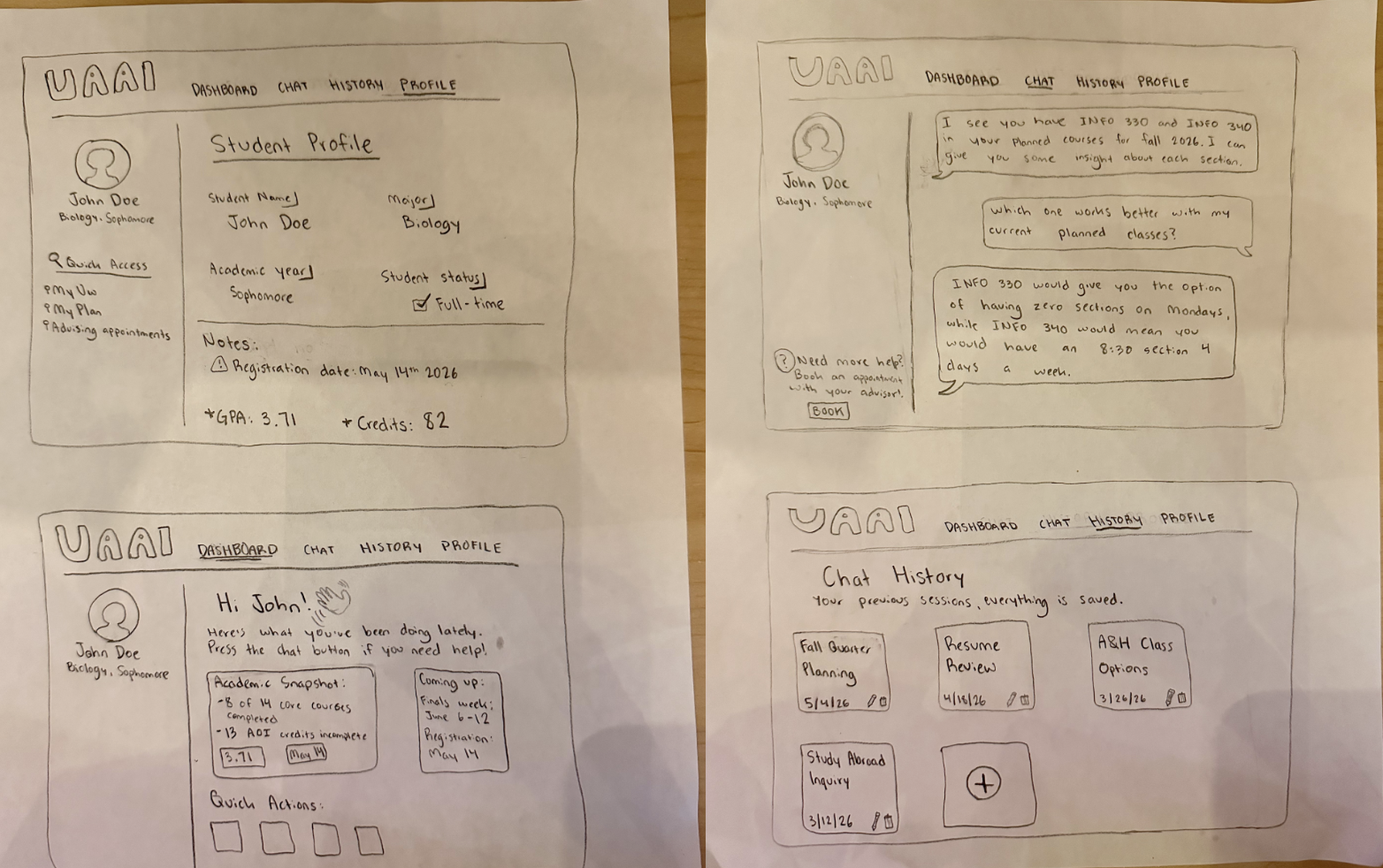
Low fidelity paper prototype
User flow diagram
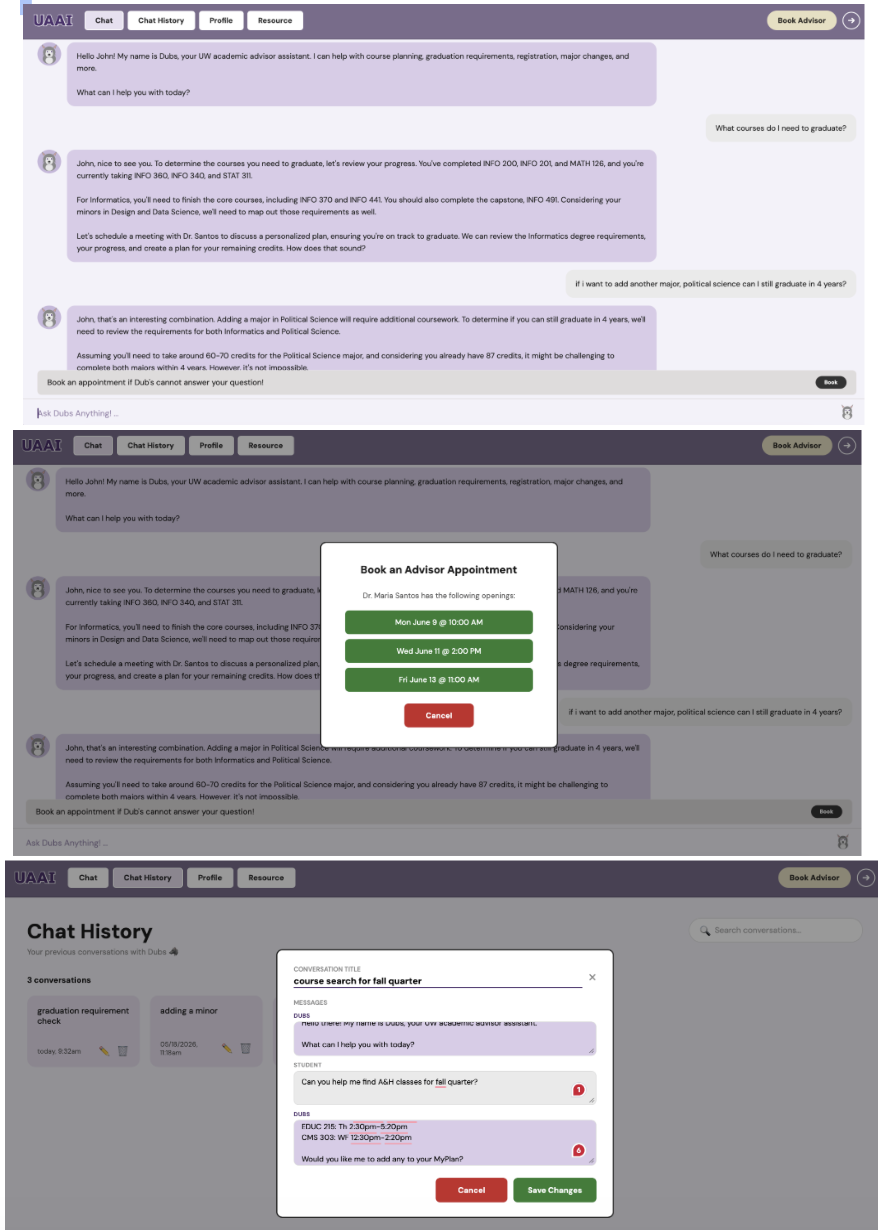
Interface mockup
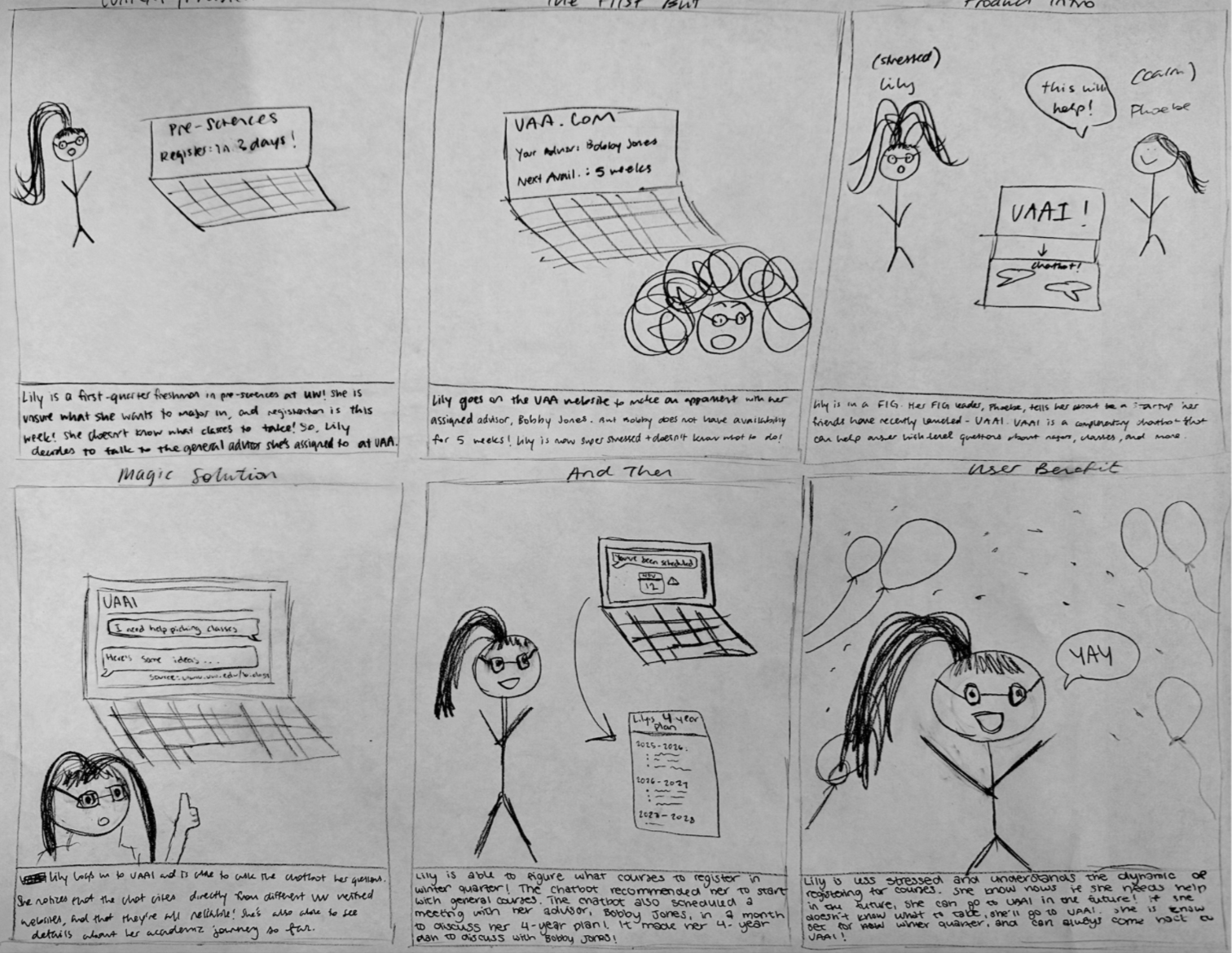
Storyboard
A

AI Chat (Dubs) - The core feature and first screen after login. Students ask questions in free text or tap suggested starters like "What courses do I need to graduate?" Dubs answers using verified UW data and cites its source on every response, so students know the answer is trustworthy and not a guess.

B

Escalation & Advisor Booking - A persistent "Book Advisor" button appears on every page. When Dubs can't answer a question, it proactively surfaces real appointment slots from the student's assigned advisor. This closes the loop between AI support and human support without the student ever having to leave the tool or start over.

C

Student Profile + Chat History - UW NetID login pulls each student's academic data and makes it available across every interaction. Chat History lets students return to and continue past conversations so advice doesn't get lost. Together these features make UAAI feel like a tool that actually knows you with directly addressing the research finding that students with advisors who knew them personally rated their advising experience significantly higher.

05 Reflection & Learning

The most important section.

"Cutting features didn't seem optimal at the moment, but it forced us to get really clear on what the core experience needed to be."

  • Feedback that shaped the design: Our interview with an undergraduate advisor helped align the design with what UW would actually want. In-class user testing revealed that navigation between the chat and chat history felt redundant, leading us to simplify and make the chatbot the main home screen.
  • Challenges we faced: Keeping the platform simple while differentiated enough from existing tools was a constant tension. We had to cut scope — notifications, degree audit integration, an advisor-facing dashboard — to stay realistic about what could be prototyped and tested in time.
  • How our ideas changed: We started with a more complex navigation structure and ended up stripping it back significantly based on what users actually needed in the moment.
  • What we learned from testing: Students often don't know what to ask — usability sessions showed participants just staring at the chatbot. This led us to add conversation starters and auto-fill prompts. Citing specific UW sources made testers noticeably more confident, and reducing steps in the advisor booking flow improved completion rates.
  • What we'd improve with more time: Testing with a much wider range of students — first-gen, transfer, and under-resourced — who are exactly who this tool should serve. We'd also get advisor feedback on the final prototype and implement fuller accessibility features.
  • Design maturity moment: Realizing that trust in the source matters as much as the answer itself. When Dubs cited a specific UW webpage, testers acted on it. When it just gave an answer, they hesitated.
06 Limitations & Future Plan

No design is perfect.

Limitations

  • Testers were mostly INFO 360 students — already tech-comfortable and in-major. First-gen, transfer, and under-resourced students were not represented, despite being the target beneficiaries.
  • Advisor input was only gathered at the interview stage, not on the final prototype — so we don't know how advisors would actually respond to the finished design.
  • Accessibility features were not fully implemented, which is a significant gap for a tool meant to serve all students equitably.

Future Plan

  • Run dedicated testing sessions with first-gen, transfer, and under-resourced students, and let their feedback validate or change the design.
  • Integrate with MyPlan and DawgPath so Dubs can pull from live academic data and give proactive, time-sensitive nudges (e.g. "Your registration window opens in 4 days" or "You still haven't fulfilled your writing requirement").
  • Allow advisors to optionally drop into a chat when they have availability, bridging the gap between AI support and human connection.
  • Implement full accessibility features and explore scaling the platform to other universities and education levels.
07 References

Sources & credits.

  1. Bilquise, G., & Shaalan, K. (2022). AI-based academic advising framework: A knowledge management perspective. International Journal of Advanced Computer Science and Applications, 13(8).
  2. Thottoli, M. M., Alruqaishi, B. H., & Soosaimanickam, A. (2024). Robo academic advisor: Can chatbots and artificial intelligence replace human interaction? Contemporary Educational Technology, 16(1), Article ep485. https://doi.org/10.30935/cedtech/13948
  3. Akiba, D., & Fraboni, M. C. (2023). AI-supported academic advising: Exploring ChatGPT's current state and future potential toward student empowerment. Education Sciences, 13(9), 885.
  4. Buchanan, V. (2023). You and I Are Not the Same: A Comparison of Human and Artificial Intelligent Advisors (Doctoral dissertation, Arizona State University).
  5. Pitts, S., & Myers, S. A. (2023). Academic advising as teaching: Undergraduate student perceptions of advisor confirmation. Communication Education, 72(2), 103–123.
  6. Vianden, J., & Barlow, P. J. (2015). Strengthen the bond: Relationships between academic advising quality and undergraduate student loyalty. NACADA Journal, 35(2), 15–27.